
Encapsulated O-Rings | FEP & PFA Seals Manufactured in the USA
Encapsulated O-Rings Manufacturer | FEP & PFA Sealing Solutions
Encapsulated O-rings are engineered sealing components designed for aggressive chemical environments where conventional elastomers fail. By combining a fluoropolymer jacket (FEP or PFA) with an elastomer core, these seals deliver chemical resistance, purity, and long-term reliability.
M-Cor manufactures close-tolerance encapsulated O-rings in the USA for semiconductor, pharmaceutical, aerospace, and high-performance industrial applications.
 What Are Encapsulated O-Rings?
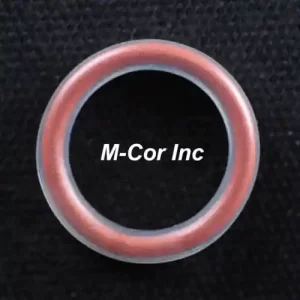
An encapsulated O-ring consists of a seamless fluoropolymer jacket surrounding a solid or hollow elastomer core.
The outer FEP or PFA layer provides:
- Exceptional chemical resistance
- Low friction
- Non-contaminating surface
The inner elastomer core provides:
- Elastic recovery
- Sealing force
- Mechanical resilience
This combination allows encapsulated O-rings to perform in environments where traditional elastomers fail.
Why M-COR ?
M-Cor is a U.S.-based manufacturer with decades of experience producing precision encapsulated O-rings for demanding industries.
What Sets M-COR Apart?
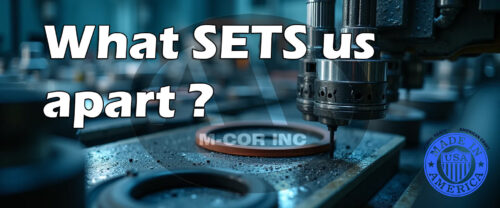
We differentiate ourselves through:
- Close-tolerance manufacturing capabilities
- In-house elastomer extrusion
- Advanced inspection using calibrated vision systems
- Full traceability and documentation
Unlike commodity suppliers, M-Cor focuses on repeatability, consistency, and engineering-driven solutions.
FEP VS PFA
FEP Encapsulated O-Rings
- Excellent chemical resistance
- Cost-effective solution
- Suitable for most industrial applications
PFA Encapsulated O-Rings
- Higher temperature resistance
- Improved mechanical performance
- Better suited for semiconductor and high-purity environments
Material selection depends on temperature, chemical exposure, and application requirements.
APPLICATIONS
Encapsulated O-rings are used in:
- Semiconductor processing equipment
- Pharmaceutical and bioprocessing systems
- Chemical handling systems
- Food and beverage processing
- Aerospace and high-reliability sealing environments
Their resistance to aggressive media makes them ideal where contamination or degradation cannot be tolerated.
Encapsulated O-Ring Tolerances (Critical Engineering Considerations)
Encapsulated O-ring tolerances are one of the most misunderstood aspects of sealing design—and a common source of failure in critical applications. Encapsulated O-rings are not molded components—they are precision-cut assemblies.
As a result, tolerances are governed by material behavior, thermal expansion, and manufacturing method rather than traditional molded O-ring standards.
M-Cor provides:
- Documented tolerance ranges
- Transparent measurement methodology
- Optional statistical inspection and certification
We work directly with customers to align dimensional expectations with real-world material performance.
Request a Quote or Speak with an Engineer
If your application involves aggressive chemicals, tight tolerances, or high-purity requirements, M-Cor can help you select the correct encapsulated O-ring solution.
📞 Call: 406-227-0477
📩 Email: customerservice@m-cor.com
Key Advantages of Encapsulated O-Rings
- Exceptional chemical resistance to acids, solvents, and aggressive media
- High purity for semiconductor and pharmaceutical environments
- Wide temperature capability
- Low permeability and reduced contamination risk
- Excellent compression set resistance compared to solid PTFE seals
Engineering Limitations & Tolerance Considerations
Encapsulated O-rings are not molded components. They are manufactured using a precision cut-to-length and welding process. As a result, they do not conform to AS568 molded O-ring tolerances and instead follow RMA-based dimensional guidelines.
Material properties such as thermal expansion, residual stress, and measurement variability must be considered when specifying tight tolerances. Claims of extremely tight ID tolerances on large diameter encapsulated O-rings often ignore these physical realities.
M-Cor provides documented measurement data and offers post-production statistical sorting when ultra-tight tolerances are required.
Engineering Considerations
Understanding tolerances is critical when specifying encapsulated O-rings. These products follow RMA-based standards rather than molded AS568 tolerances.
Elastomer Core Options
- Silicone (standard for flexibility and temperature range)
- FKM (Viton®) for enhanced chemical resistance
- EPDM (including PFAS-free options)
Engineering Resources
- M-Cor Groove Assistant- Groove Aid Design for Engineers
- Monte Carlo Tolerance Simulation – Simulator for establishing yields
- Weight Calculator- Determine the weight of any extrusion Silicone, FKM, Tubing
- Encapsulated Overall Shore Hardness Calculator- Tool for determining hardness for force calculations
- A simple Mean Diameter Calculator
These tools are designed for encapsulated o-ring applications
Why Encapsulated O-Rings Fail (and How to Avoid It)
Common causes of failure include:
- Incorrect tolerance expectations
- Improper groove design
- Thermal expansion mismatch
- Selecting FEP vs PFA incorrectly
M-Cor works directly with engineers to prevent these issues before they occur.
Frequently Asked Questions
Here is a link to our complete FAQ
What is the difference between FEP and PFA?
PFA offers higher temperature resistance and improved mechanical performance compared to FEP.
Are encapsulated O-rings suitable for high-purity applications?
Yes. They are widely used in semiconductor and pharmaceutical environments due to their low permeability and chemical resistance.